


Our Focus
Richmond Primary School aims to provide every student with a comprehensive, engaging and differentiated curriculum that responds to their diverse learning needs, interests, backgrounds and aspirations.
We believe all students can learn and achieve to their highest ability when provided with high-quality teaching, appropriate challenge, targeted support and opportunities to develop independence. We develop a range of learning experiences that aim to
- develop a love of learning
- promote excellence in learning
- develop self-esteem, confidence, risk-taking and independence
- develop curious, creative, collaborative and critical thinkers
- build students’ capacity to explain, justify and reflect on their thinking
- provide students with the knowledge, skills and dispositions required to become successful lifelong learners
- connect learning to students’ lives, the local community and the broader world.
The following key learning areas are considered important components of the curriculum:
- English
- Mathematics
- Inquiry
- Physical Education
- STEM
- AUSLAN
- Performing Arts
- Visual Arts
In addition to core areas of learning, we offer a range of student enrichment programs to stimulate, extend and excite our students, including:
- School Camp (Year 3/4 & 5/6)
- Interschool Sport (Year 5/6)
- Whole School Production
- Arts Gala
- Incursions and excursions
- Swimming and water safety
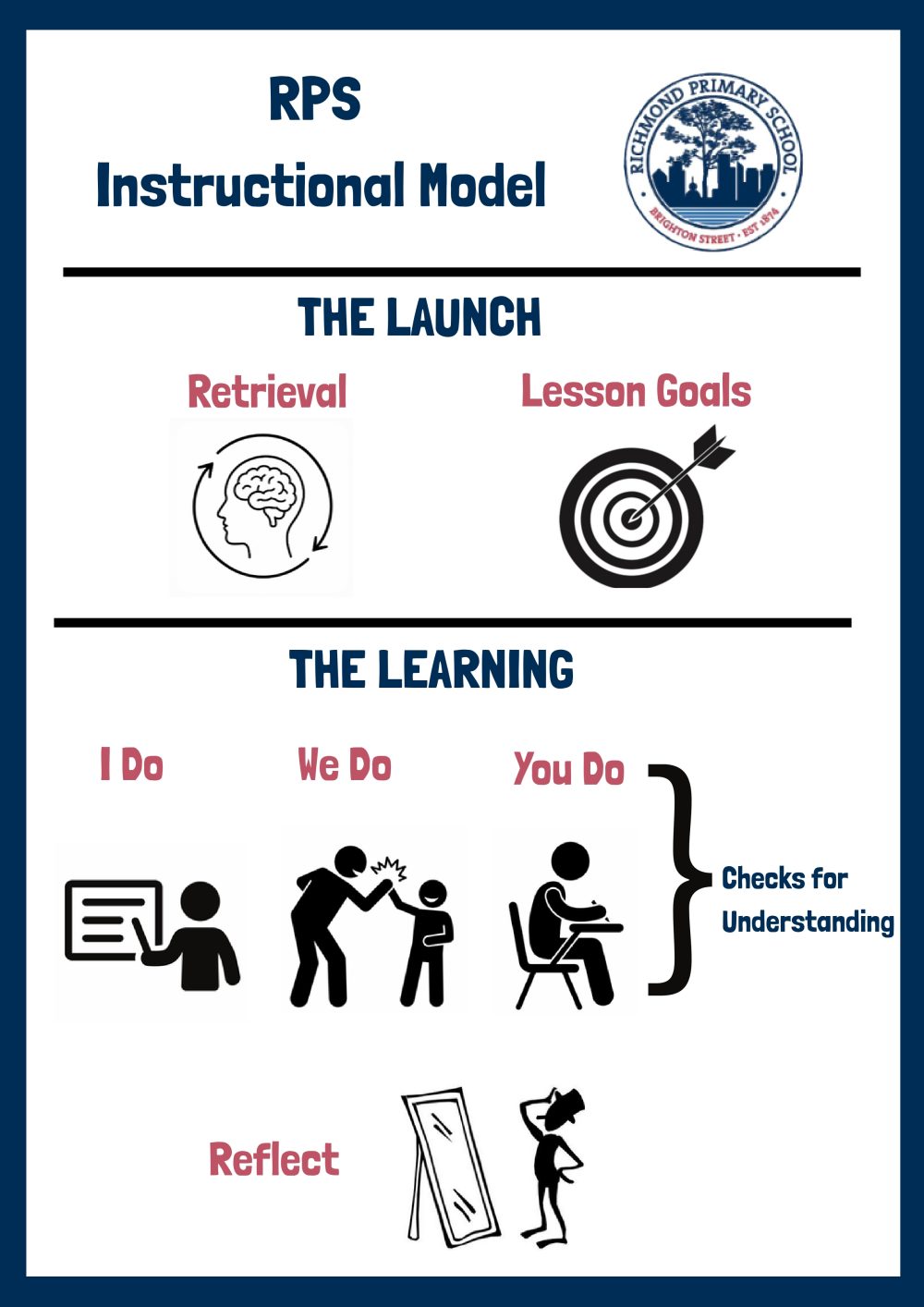
The RPS Instructional Model
The RPS Instructional Model provides a consistent framework for high-quality teaching and learning across Richmond Primary School. It is organised around three phases: The Launch, The Learning and Reflect.
The Launch
The Launch prepares students for new learning by connecting the lesson to what they already know and establishing a clear purpose by:
- using retrieval and review to access prior learning
- activating and connecting with students’ existing knowledge
- building student confidence and readiness to learn
- establishing and communicating clear Learning Intentions and Success Criteria
- explaining the purpose and relevance of the learning
- identifying and responding to students’ prior knowledge and misconceptions.
The Learning
The Learning phase is where new knowledge, skills and understandings are explicitly taught, practised and applied.
The Gradual Release of Responsibility Model supports students to move from teacher modelling to guided practice and increasingly independent application.
The release of responsibility is responsive rather than necessarily linear. Teachers adjust the level of support according to evidence of student understanding. This includes:
- checks for understanding regularly
- the use of responsive teaching to address misconceptions and learning needs
- providing timely and purposeful feedback
- incorporating flexible groupings where appropriate
- providing opportunities for collaboration
- providing additional support, intervention or extension as required
- gradually reducing scaffolding as students develop confidence and independence.
Reflect
Reflection provides students and teachers with opportunities to consider the learning that has occurred. Students reflect on what they have learned, what went well, areas for improvement and the strategies they used. Teachers use evidence gathered during the lesson to inform subsequent planning and teaching.